Saturday, September 20, 2014

Does Your Basenji Purr?


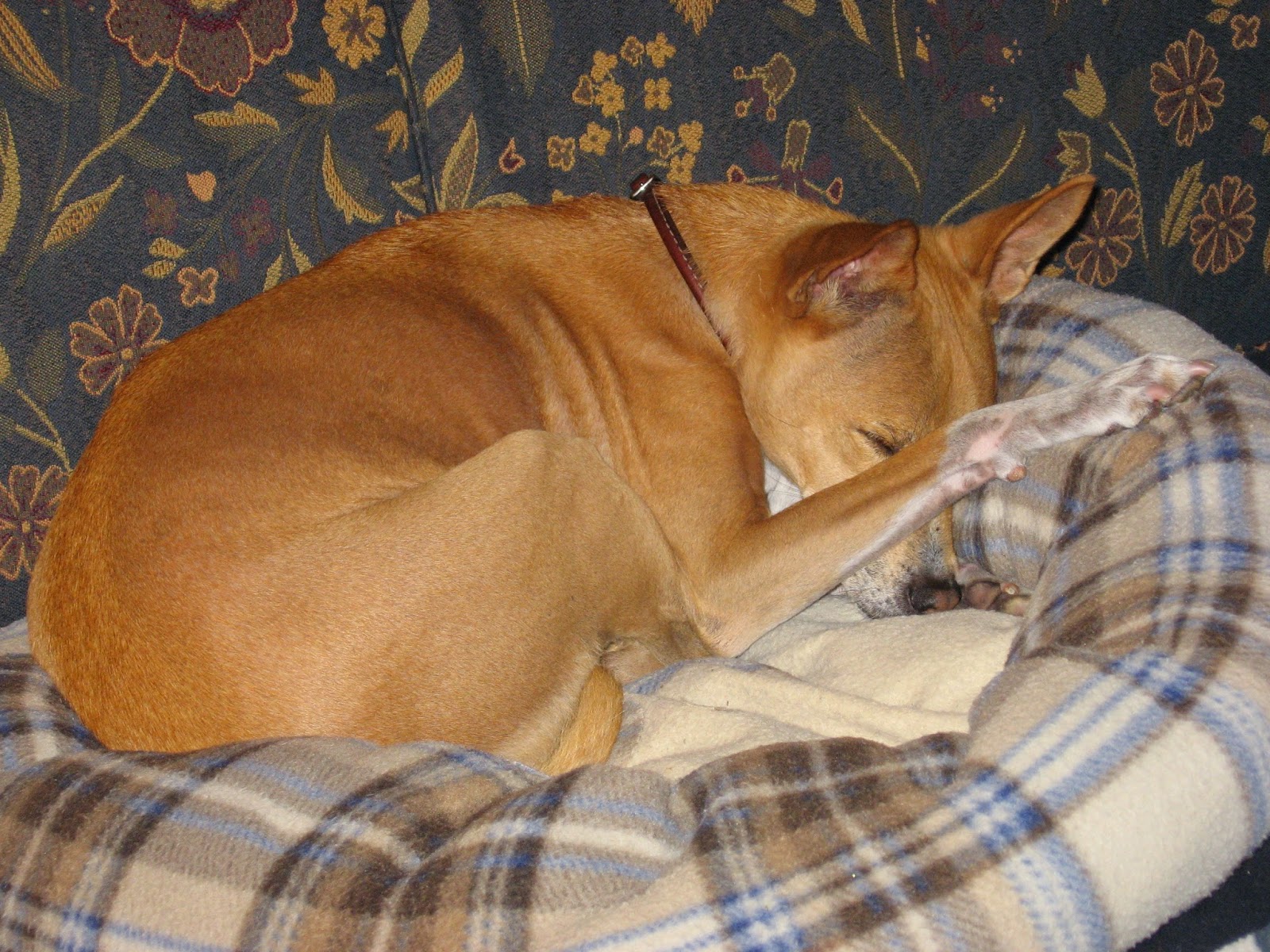
Basenjis are known to be catlike. They fastidiously clean themselves. They are independent and generally do not like to get wet. Damp grass is dreadful, rain even more so. They bat at things with their paws the way cats do, and they often possess the cat’s commando-like ability to climb fences.  Does this similarity extend to purring when they’re happy?
Ivan and Dasa issue forth an extraordinary repertoire of sounds, hums, chortles, snorts, and groans. When Ivan is happy, he makes a variety of contented noises.  Rub his back, massage his ears, stroke lazy circles on his tummy, and his sounds of contentment seem a great deal like happy purrs. Sometimes he also offers the whirring mini helicopter noises guinea pigs make. He makes low rumbling noises that are punctuated by sighs.  From time to time he makes little chut chut chut noises as though he’s a contented barnyard chicken. Sometimes it’s an under his breath delighted woobling, almost like a pigeon cooing.
   When Dasa is snuggled into a comfy spot, or receives cuddles, tummy rubs, or gentle scratchies behind her ears, she signals her blissful state with purrs that are more like peaceful sighs.
 
 And then there are the mumbles when Ivan is not pleased with something, but the dissatisfaction is not serious enough to warrant outraged yodels, (“Where’s my dinner? I could starve and die right here!”)  These are the times when he mutters under his breath about the general lack of service, having his muddy feet cleaned, or some other indignity. This complaining sounds like any adult in a Charlie Brown film:  “Mwah mwah mwah, mwah mwah.”

And so, well-trained basenji slaves that we are, we work to improve service and solve the problem so we once again hear happy little purrs, those wondrous quiet sounds of contentment.
 

Friday, September 12, 2014

Intractable retractable? A "restrained" word on leashes...

For 18 years and 3 Basenjis, I have used retractable leashes almost exclusively.  I am fortunate enough to live in an exceptionally dog-friendly neighborhood with an abundance of green space. On those days when we can't get down to the park, I can pull out the 26-foot retractable leash and Clover Four Leaf can run around like a heathen in the open field behind my house. While the retractable gives her a wee bit of controlled freedom,  I suppose I really enjoy the freedom the retractable gives me: if you've ever developed a bad case of "sweaty-itchy-red palm" from the constant wadding and un-wadding of a standard leash, then you know how I feel. My frustration with standard leashes is so untenable, that I limit their use to walks downtown or trips to a crowded place of business.
 
BUT.....
 
As practical as retractable leashes can be for certain situations, they do take some practice to master. Arguably, learning to work the brake and the brake lock can take more coordination than driving a stick shift. First-time dog walkers may need even more practice with the retractable before "road testing" it. Furthermore, using a retractable with a puppy or with a poorly trained pet is not recommended. And adding injury to insult is no joke! Rope burn and even dismemberment have occurred with retractable leashes. The potential injury risk is often cited as the main reason these type of leashes have a bad reputation.

All facts, pro and con, should be taken into consideration when choosing a leash that is right for you and your Basenji. If you decide that a retractable can fit your needs, here are a few tips and a short video to help you make the most of it:
 
  1.   Read all instructions that accompany the leash. Not only will they help you to master the leash more quickly, but understanding these instructions can help to prevent injury. 
  2.   Remember to engage the brake button before your Basenji is too far away. The brake lock can keep the dog at a set distance, without constantly engaging the brake button.
  3.   Practice, practice, practice. No one is good at anything the first go round. Don't blame the product for "user failure".
  4.   Some situations are more appropriate for retractable use than others. Don't give your dog 16 feet of freedom on a crowded street or in a pet store.
  5.    To thine own Basenji be true. Only you can know what's best for your dog. Stick with what works for you!

Tuesday, September 9, 2014

The Begging Circle

In our house, eating is often a competitive activity.  Not human vs. human, but mostly human vs. basenji.  Any time we have food in our hands (which, admittedly, is quite often), we have two furry followers at our heels, waiting patiently for a handout or a dropped crumb.  When we go on vacation with my parents the begging circle expands to three, as my parents' Shiba Inu, Tucker, is also a consummate beggar.  And now, it looks like we have a human addition to the begging circle: the baby is getting in on the action! 

My father, trying to eat a sandwich amid his loyal followers
Much to the dogs' dismay, the baby gets priority over the handouts :-)  Sometimes, it's tough to be a dog! 

Monday, September 8, 2014

The Transformation of Vincent Van Gogh

We have previously written about Benny's ever-evolving story and Tess's amazing beginning-of-life story, and now we will write about Vincent Van Gogh’s transformation back to dog-hood.

I first heard about VVG when the BRAT coordinator, Linda Webb-Hilliard, emailed Terrie to find out if we could help with a Basenji in need. Linda told us he was in distress at the foster-to-adopt home he had been placed in four months prior. She sent me information about VVG and how he came to be in rescue.
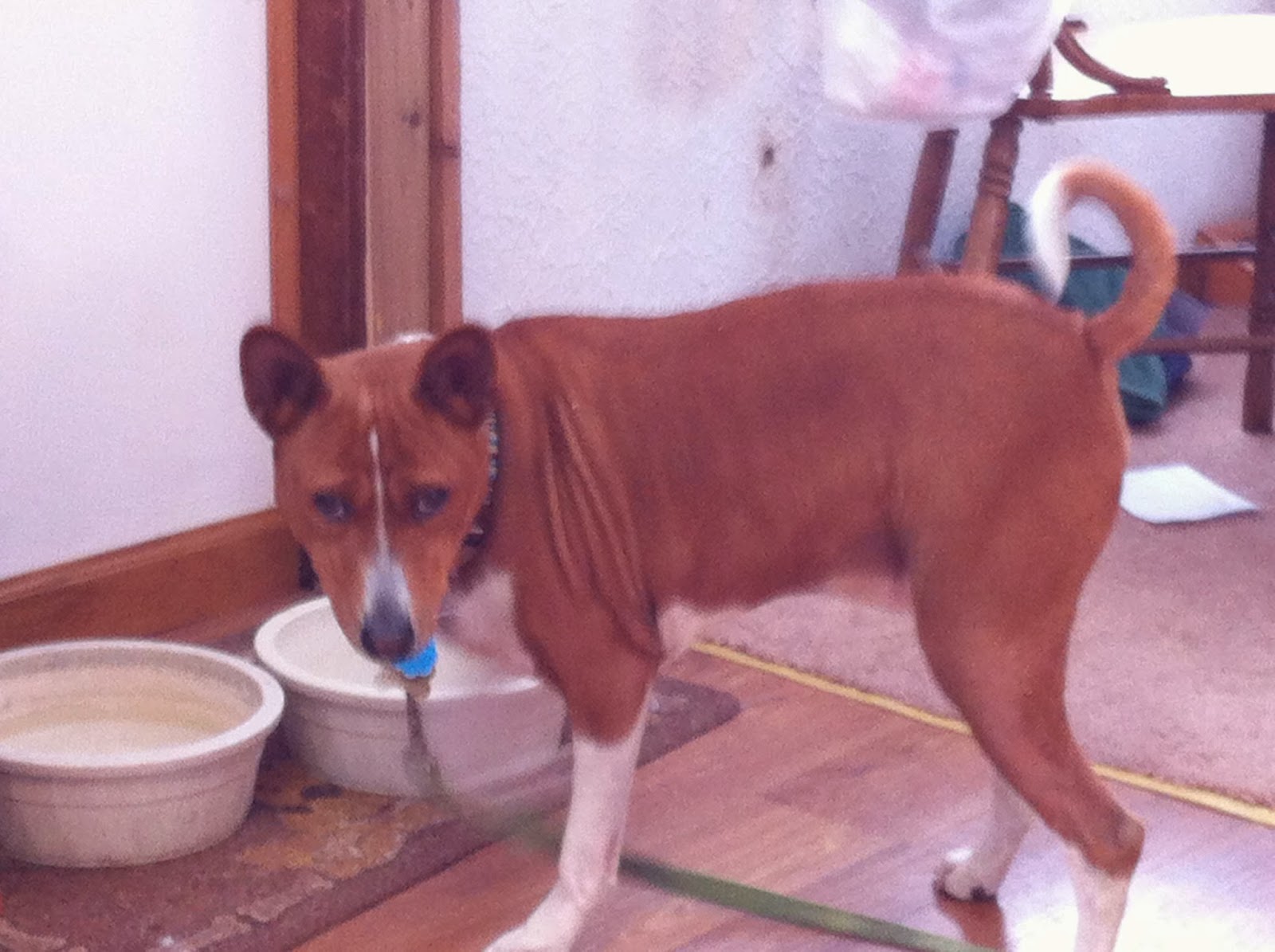
VVG in October 2013

VVG had lived with a single male from about two months old until he was eight years old. The man got into a relationship with a woman who had a couple of young children and several cats. After a trial period the man relinquished VVG to BRAT for re-homing, saying he didn't get along in the new family dynamic.

Linda brought VVG into her home to evaluate and vet him fully before placing him for foster or adoption. After she was sure VVG was ready to go, Linda settled on a young man who had just lost his female Basenji of many years. She personally did the home visit and interview and felt he was a good placement for fostering-to-adopt VVG. So VVG was off to his new home, which had a similar family dynamic to his former life.

A couple of months later Linda was contacted by VVG's new foster family who said he was not working out. His foster parent indicated VVG was acting out and had started biting people, especially the children. He also said VVG would not listen to him and stay out of the kitchen, like his former Basenji would do. VVG's foster parent explained to Linda that not long after VVG came to live with him they went to Tennessee for a family get together. VVG's foster parent went out with some of the other adults and left VVG with several adults and children whom VVG did not know. Evidently the children picked on VVG enough that he snapped at them. VVG's foster parent was informed of this and that they had "disciplined" him. VVG's foster parent then said VVG was biting and snapping more and more as time went on and would not listen to him.

This is when Linda contacted Terrie about us possibly helping. We, of course, agreed to help and I made contact with VVG's foster parent to arrange for me to pick up VVG and bring him home with me. Finally, October 6th 2013, I drove from Indy to Lexington to pick up VVG. When I arrived, I walked into the house and the first thing VVG did was sniff my fingers then snap at them. Nothing overly aggressive, just a hit and run type of attitude. I finally got VVG into the car and headed out, and the first thing I noticed was that he was very stressed and agitated.

After a very interesting three hour drive, we arrived at VVG's new temporary home. We came into the house and VVG immediately began exploring. The pack was outside in the back yard while VVG checked out his new surroundings. At this point I brought Benny into the house to begin the introductions. The usual sniff-fest took place, then something very un-Benny like happened. Benny let out a snarl and took VVG to the ground. Benny stood over him and let VVG know what was expected of him. Benny then walked away and let VVG up. After VVG got up, Benny came over and play bowed and tried to get VVG to play, which was not going to happen anytime soon. Then, one by one, Willow, Tess, and Mr. Bear came into the house and introduced themselves to VVG. Nothing as dramatic as meeting Benny, but pretty intense just the same.

Terrie and I then set about the business of getting to know VVG and learning what we could about his trauma, sometimes the hard way. The first evidence came very quickly when we were putting the pack outside and VVG was hesitant by the door. I put my hand on the back of his head and VVG turned and bit it without warning. I put a lead on his collar and was able to take him outside. When we brought him back in we were able to examine his head area and discovered that it was badly swollen on the left side and was tender. We introduced him to a crate and he was resistant to going in and struggled to stay out. We worked with him to make him comfortable in the crate and to teach him it was his safe zone anytime.

I took him to the vet to get his head checked out, as well as a strange looking discoloration on his belly and loins. It turned out out the discoloration was a severe staph infection most likely caused by spending a great deal of time in a damp environment. His head was tender and swollen, but fortunately his eyes and ears appeared normal, so the likelihood of permanent damage was slight.

About a week after I was bitten, Terrie was putting him outside and reached down to grasp his collar and VVG turned and bit her on the forearm. We were learning the triggers that caused him to defend himself, two of which were reaching for the head or the collar. I am of the belief that he was held by his collar and beaten about the head and shoulders. To this day VVG occasionally reacts when I put my hand on his head in certain situations, but the reaction is pulling back with a warning huff.

There were many incidents of nipping the hand and attempting to bite and pulling back early on, which became fewer and farther between with Terrie and I, however VVG would not allow anyone else near him until early December, when a couple of dog savvy people came to visit. VVG took his time to check out the visitors and within an hour he was sitting in their laps. At the end of December our son came to visit for the holidays. VVG was very aloof initially, but he eventually warmed up to my son and spent much time in his lap.

We watched all of this interaction very closely to prevent any incidents, but despite that, another incident happened. A friend reached across a baby gate that separated VVG from the room and he bit her hand without warning. It was a puncture wound with no tearing and fortunately healed quickly. We were trying to figure out what the trigger was that caused this behavior, and we eventually realized that our friend had extended a closed hand to VVG, and its resemblance to a fist caused the reaction. The realization came about two months later when, not paying attention, I was asking VVG to go out and inadvertently pointed a fist toward him and he bit me. This was also a puncture wound with no tearing, which indicated a warning bite. I looked at him and said "Dumbass, you still need to go out,” and he went to the back door where Terrie let him out. That was in the beginning of March and we have not had any more biting incidents since then.

This was the turning point in VVGs transformation. VVG had been exposed to my six year old grandson on a regular basis during this time, with no interaction allowed. At one point, VVG pushed over the baby gate and checked Caleb out. Once he was done, VVG came over to me and laid down. From this point forward there was no more separation and VVG has shown no aggression toward him at all. VVG has been introduced to more and more people, with no incidents of aggression. The key for VVG is to let him initiate the contact and allow him to check the person out.

Along with all of the behavioral changes, we finally got VVG’s thyroid issues stabilized with medication. We attended the BRAT convention in Syracuse, NY in June 2014, and VVG was a big hit, getting some much needed exposure to other people and Basenjis with no incidents reported. VVG made some new friends, two legged and four legged alike.

In discussions with Linda, we decided it was time to begin the process of finding the right home for VVG to live and prosper in. It would have to be a special home where the prospective family understood a potential biter, and would be patient with VVG to help him completely heal. There were a couple of people familiar with VVG who expressed interest in adopting him, but whose current situations did not allow for this to happen. Linda received several promising inquiries into adopting VVG, however there were a few remaining concerns which ultimately led to the final path of VVG’s life.

VVG in September 2014

With those concerns about VVG’s welfare and mental state from having to make another major change in his life after the last ten months of stabilizing his environment, and concerns about how the prospective family would react to VVG if he attempted to bite or bully his new family, ultimately, the decision was made for VVG to remain with us. So, on August the 7th 2014, the Sigler pack grew by one member when the adoption of VVG was official.

~Dean and Terrie Sigler, and the Sigler Pack:
Willow, Benny, Tess, Mr. Bear, and our newest member VVG
(Edited by Ellen Campbell)

Friday, September 5, 2014

Destruction Contests


One of the most popular categories in the Basenji Companions’ on-line photo contest is the Destruction Category. Basenji lovers proudly send photos of the carnage left in their basenji’s wake and then vote for the coveted Destruction Award.  What will it be?  The third chewed TV remote in a single season? The shredded blinds? The severed seat belts? The thoroughly customized articles of clothing? The leather ottoman? The many decimated books?  It’s so difficult to choose. While just a way of life for Basenji parents, this celebration of our magical curly tails’ ability to outsmart us is bewildering to the uninitiated.

Over the weekend we struck up a conversation with some nice folks who mentioned their dog Daisy, apparently a paragon of canine virtue.  A (non-basenji) rescue, Daisy is sweet, loving, and has nary a bad habit. They confided that occasionally Daisy licks the cat’s dish, but at a single “No,” she stops. Doesn’t eat the cat food, doesn’t chase the cat, doesn’t chew anything. This is so far removed from reality as we know it that we can scarcely conceive of this.

I spoke animatedly about Ivan and Dasa’s endearing habits and often astonishing powers of destruction. As Daisy’s mom’s expression grew more and more alarmed, I said breezily, “You have to be a little nuts to have a basenji. (pause) We have two.” Surprisingly, this did not have the reassuring effect I intended.

I decided not to mention the following destruction tale as I was reasonably sure Daisy’s parents were even more delighted with her than before we spoke, and I saw no reason to trouble them with further evidence of Ivan and Dasa’s extreme cleverness.

Yet another destruction tale: When I came home one evening Eric said, “Something happened.” It seems the embroidered wedding sampler I had been laboring over for months had caused offense and been summarily chewed.  I said, “Where’s the needle?” The needle had been discarded in the rug, so there was no immediate crisis.

The culprits, probably elves, had disposed of a large corner of the fabric, but had graciously stopped about an inch away from my embroidered stitches. Fortunately, the frame shop was able to rescue the savaged remains and hide all evidence of the alterations. No elves or small dogs suffered any digestive consequences, so all was well.

This was, of course, my fault for failing to realize the elves were capable of accessing that particular storage spot. A higher flat surface was required for future safe keeping.

How sedate life would be if basenjis did not exhibit a lively curiosity in their surroundings and a willingness to help with any number of projects.


The Innocent Elves

Tuesday, September 2, 2014

BRAT's Website Has a New Look

Basenji Rescue and Transport's website has been up and running on the Internet since 1997. Over the years, the site had evolved and continued to run smoothly, but our web designers knew it would need a new, more modern look and feel eventually. They also hoped that, when that time came, developments in programming would also ease time-consuming maintenance issues.

The time has come. In mid-July, Don Kuhwarth (BRAT's Chief information Officer and web developer) took on the arduous task of modifying our site. We think it’s both better looking and easier to navigate.

A site should look good but also run smoothly and have an easy-to-understand structure. Behind the scenes, the immense number of files and components must work together harmoniously. Don has updated the site so it runs smoothly behind the scenes and looks fresh and fabulous for a better user experience. We think you will be impressed with the new site's fonts, colors, layout, and photos.

The new header is neat and tidy, and features the new BRAT logo created by BRAT volunteer Mark Ziegler. Additional information about available Basenjis is an easy click away at a "read more" link. There are "Good, Bad, and Ugly" reality stories, as well as educational features about shedding, dental procedures, and health information, as well as many links to information about food, training, other Basenji sites, and organized activities for you and your Basenjis. And, of course, there are links to BRAT's adoption, volunteer, and donation forms!

If you haven't visited the new and beautifully improved Basenji Rescue and Transport website yet, take a look at www.basenjirescue.org. We'd love to hear what you think!

Kudos and thanks to Don!